
Client Overview
The client operates a critical infrastructure facility with fire-fighting and utility systems comprising water storage tanks, diesel storage for generators, and pump rooms with multiple electrically driven pumps. Continuous visibility of water availability, diesel levels, pump status, and pressure conditions was essential for operational readiness, compliance, and preventive maintenance.
The client required a reliable IoT solution capable of acquiring sensor data, monitoring digital inputs, and securely transmitting validated data to their backend system.
Project Objectives
- Enable continuous and accurate measurement of water level, diesel level, and water pressure.
- Digitize the operational status of key fire and utility equipment.
- Provide remote access to live and historical data using GSM-Activated communication.
- Ensure seamless integration with the cloud dashboard.
- Deliver a robust, easy-to-install solution suitable for industrial pump room environments.
Solution Design
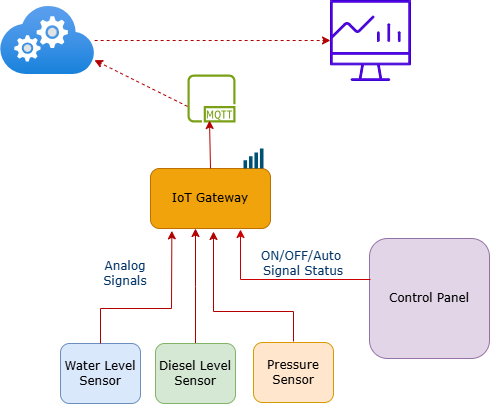
Key Deliverables
- Water Level Sensor
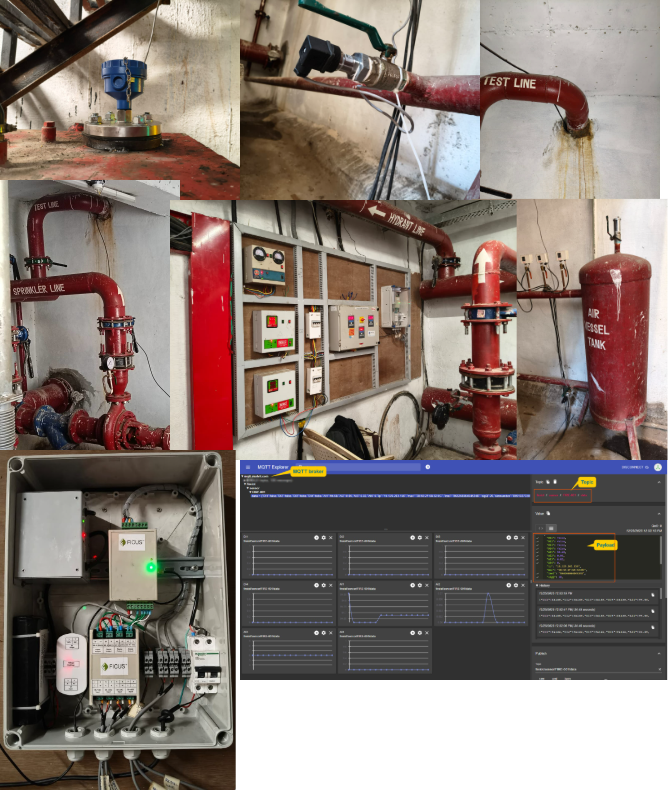
- Installed, tested, and readings verified against actual tank levels.
- Diesel Level Sensor
- Installed, calibrated, and data accuracy validated.
- Pressure Transmitter
- Installed with verified signal scaling and pressure readings.
- Digital Inputs
- Four digital inputs configured and tested:
- Jockey Pump (used AC-DC convertor)
- Sprinkler Pump (used AC-DC convertor)
- Hydrant Pump (used AC-DC convertor)
- Diesel Generator
- Four digital inputs configured and tested:
- MQTT Data Publishing
- Live sensor and status data successfully published and verified on the cloud dashboard.
- Final Installation
- IoT device, SMPS, Battery backup, MCB etc inside the panel.
- Panel installed in the pump room and commissioned successfully.
- IoT device capturing data from the installed sensors and sending it to cloud using GSM.
Value Delivered to the Client
- Elimination of manual inspections for routine monitoring.
- Centralized monitoring of critical infrastructure assets and early detection of abnormal conditions.
- Improved emergency readiness for fire-fighting and power backup systems.
- Enhanced reliability and compliance with safety requirements.
- A future-ready IoT platform aligned with industrial standards.
Conclusion
The project successfully delivered a robust IoT monitoring solution that transformed manual, fragmented monitoring into a centralized, automated, and reliable system. The integration of sensors, digital inputs, and MQTT-based data transmission provided the client with actionable insights, improved system availability, and long-term operational confidence.